Cann We Chat?
Learn More
Explore our resources below to learn more about why you should be concerned and what steps you can take with your own kids around this important topic.


Frequently Asked Questions
How many youth in Missoula use marijuana?
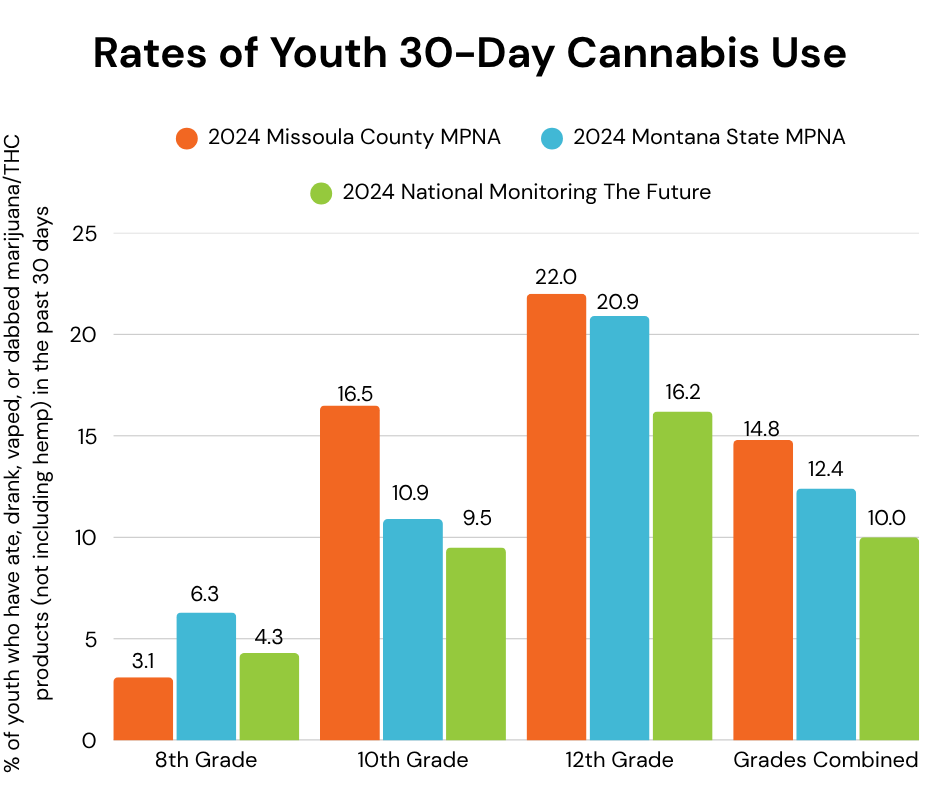
Rates of Youth 30-Day Cannabis Use
% of youth who have ate, drank, vaped, or dabbed marijuana/THC products (not including hemp) in the past 30 days. Data is from the Montana Prevention Needs Assessment (MPNA) and Monitoring the Future.
| Data Source | 2024 Missoula County MPNA | 2024 Montana State MPNA | 2024 National Monitoring the Future |
|---|---|---|---|
| 8th Grade | 3.1% | 6.3% | 4.3% |
| 10th Grade | 16.5% | 10.9% | 9.5% |
| 12th Grade | 22.0% | 20.9% | 16.2% |
| Grade Combined | 14.8% | 12.4% | 10.0% |
Is my teen going to be pressured to try cannabis soon? How can I prepare them?
In Missoula County, 48.6% of students (8th-12th grade) say that at least 1 or more of their 4 best friends have used marijuana in the past 12 months (2022 Missoula Montana Prevention Needs Assessment).
Prepare your child with REAL Refusal Training: Refusal Training is an easy and effective way to teach youth how to say no while under pressure. While refusal training is generally focused on refusing alcohol, tobacco, and other drugs (ATOD), it can also be utilized to teach students how to say no in any uncomfortable situation. Additionally, though adults can facilitate the training, refusal training is most effective when it’s taught by peers. This provides a more comfortable space for them, so talk with your child with their siblings or friends present. There are four steps of refusal skills: Refuse, Explain, Avoid, and Leave. After talking about these four options, practice refusal skills by talking through different scenarios with them
REAL Refusal Skills:
Refuse: Teach students to say “no” and be firm and confident while doing so. Remind them of reasons to say no: ask them what their dreams and aspirations are and how substance use could impact them.
Explain: Provide students with examples of explanations – they can be honest or made up: “We have school tomorrow, I need to be sober,” “I can’t vape because my parents drug test me,” “My cousin had a bad reaction to dabbing,” or “I don’t want to get in trouble.”
Avoid: Avoid situations that are hotspots for ATOD-use, including parties or bonfires. Talk with students about situations where ATOD may be present.
Leave: If students attend a party or social gathering where ATODs are present, they need to leave immediately to avoid peer pressure, injury, or legal consequences.
How do I talk about cannabis use in a way my teen will actually listen?
Talking to your kids about substance use can be challenging, but these conversations need to happen. An easy way of bringing up the topic would be to relate it to something your teen has seen or experienced recently. For example, if you are driving and you hear an ad on the radio for a dispensary, or if you have recently seen a tv series that shows substance use, you could ask your child what their thoughts are on the subject. Informal conversations like this may feel more relaxed and natural than if you sit them down to have “the talk.” Your teen will likely be more open to continuing the conversation if they don’t feel cornered or pressured. For more support, you can utilize SAMHSA’s “Talk. They Hear You.” mobile app, which helps parents and caregivers prepare for some of the most important conversations they may ever have with their kids. It shows you how to turn everyday situations into opportunities to talk with your children about alcohol and other drugs, and equips you with the necessary skills, confidence, and knowledge to start and continue these conversations as your kids get older.
Additional Resources
- SAMHSA: Talking with Your Teen about Marijuana
- Talking to Teens about Marijunana – UMN Extension
- Why – and how – to Talk to Your Teen and Young Adult about Marijuana Use
- Talking with your Teen about Marijuana Use – Standford Medicine Children’s Health
- Parenting Montana Podcast – Having Conversations about Alcohol and Drug Use
I found out my teen has tried cannabis. What do I do now?
If you have noticed signs that your child may be using cannabis, or they have told you they are, the best thing to do is talk to them about it. Express your care and concern for them, while explaining why using cannabis is not a healthy coping mechanism. Studies have shown that cannabis use is actually linked to increased rates of anxiety 3, 4, depression 1 and suicidality 2,5. If your child is using cannabis because they believe it will help, gently correct them and assist with building healthy resiliency skills or finding professional support. A list of local mental health resources can be found by clicking the “Find Help” button below.
1) Kedzior, K. K., and L. T. Laeber. 2014. A positive association between anxiety disorders and cannabis use or cannabis use disorders in the general population—A meta-analysis of 31 studies. BMC Psychiatry 14:136.
2) Blanco, C., D. S. Hasin, M. M. Wall, L. Florez-Salamanca, N. Hoertel, S. Wang, B. T. Kerridge, and M. Olfson. 2016. Cannabis use and risk of psychiatric disorders: Prospective evidence from a U.S. national longitudinal study. JAMA Psychiatry 73(4):388–3
3) Feingold, D., M. Weiser, J. Rehm, and S. Lev-Ran. 2016. The association between cannabis use and anxiety disorders: Results from a population-based representative sample. European Neuropsychopharmacology 26(3):493–505
4) National Academies of Sciences, Engineering, and Medicine 2017. The Health Effects of Cannabis and Cannabinoids: The Current State of Evidence and Recommendations for Research. Washington, DC: The National Academies Press. https://doi.org/10.17226/24625.Borges, G., C. L. Bagge, and R. Orozco. 2016. A literature review and meta-analyses of cannabis use and suicidality. Journal of Affective Disorders 195:63–74
5) Shalit, N., G. Shoval, D. Shlosberg, D. Feingold, and S. Lev-Ran. 2016. The association between cannabis use and suicidality among men and women: A population-based longitudinal study. Journal of Affective Disorders 205:216–224
How could cannabis use negatively impact my teen’s health and brain development?
The brain isn’t done developing until around age 25, so if an adolescent is using substances like cannabis, their brain’s health can definitely be affected. Drugs interfere with the way the brain sends, receives, and processes signals through neurotransmitters (the chemical messengers of the brain). In the case of cannabis, as THC interacts with the brain it speeds up the electrical pulse that sends these messages. A good way to describe this is that your brain is receiving too many messages at once. Your mailbox is overflowing with messages, and because you can’t read them fast enough, there are messages that aren’t getting through. When your brain is overwhelmed like this it tends to hyper-focus on just one message at a time, and doesn’t learn to prioritize.
Cannabis affects your entire brain, so over time with repeated use it could cause:
Impacts on academic performance: Shorter attention span, Difficulty concentrating, Harder time studying or remembering things, Fatigue and tiredness, Poor academic performance.
Impacts on physical health: Slower reaction time, Decreased endurance, Poor coordination, More difficulty developing muscle, Higher likelihood of injury, Abnormal heart rate leads to poor blood circulation.
For more information on how the THC in cannabis can impact brain health, check out the following videos:
Should I set strict rules about cannabis use? What consequences are appropriate?
The earlier you begin having conversations about drug use with your kids, the more effective a deterrent it will be. Knowing what the laws are may provide a good starting point for discussion with your family:
Youth use of cannabis is NOT legal in Montana until the age of 21 (or 18 with a medical card).
When setting rules for your family it is important to discuss the “why” rather than just giving a blanket “just say no” rule. Explain that in addition to the law, you care about their health and want them to succeed in life. Express that you don’t want them to use cannabis underage, and explain the consequences (both legally and for your family) for what would happen if they are caught using. In the case of setting consequences, ensure that the punishment matches the crime. For example, if they skipped school or left class early you might assign them a few extra hours of studying at home to learn what they missed, rather than allowing them to hang out with friends.
Tips for Setting Clear Rules about Substances
- Knowing what the laws are can help provide a starting point for discussion.
- Plan ways for youth to manage peer pressure situations. Practice conversations and refusal training.
- Have a “codeword” with an escape plan.
- Teach them to only accept a beverage when they know exactly what is in it.
- Help your children avoid dangerous situations such as riding in a car driven by someone who was drinking.
- Establish a curfew or guidelines for activities if an adult is not present.
- Tell an adult where you are going, and let the same adult know when you arrive.
Check out the two ParentingMontana.org podcasts below for more ideas on how to talk to your kids about drug use and set clear rules:
For Kids and Tweens: Guidance and Discipline for Skill Building Podcast
For Tweens and Teens: Having Conversations about Alcohol and Drug Use
Could cannabis use lead to my teen falling behind in school or dropping out?
Yes, cannabis use can impact your child’s academics. Studies have shown that marijuana use is associated with shorter attention spans, problems with cognitive learning ability, and memory issues1, 2, 3. These effects can linger long after use, as the brain is trying to recuperate6.
“Students who frequently smoke marijuana tend to get lower grades, have higher truancy and are more likely to drop out of high school4. Studies have shown that compared with students who never use marijuana, those who were daily users before age 17 had a clear reduction in rates of high school graduation and also a reduced chance of achieving a college degree5. In fact, teens under the age of 17 who use cannabis daily are 60% less likely to graduate from high school than their peers4.” – Teens and Drugs – How Cannabis Affects School Life – MJ FactCheck
1) “Broyd, S. J., H. H. Van Hell, C. Beale, M. Yucel, and N. Solowij. 2016. Acute and chronic effects of cannabinoids on human cognition—A systematic review. Biological Psychiatry 79(7):557–567
2) Batalla, A., S. Bhattacharyya, M. Yucel, P. Fusar-Poli, J. A. Crippa, S. Nogue, M. Torrens, J. Pujol, M. Farre, and R. Martin-Santos. 2013. Structural and functional imaging studies in chronic cannabis users: A systematic review of adolescent and adult findings. PLOS ONE 8(2):e55821.
3) Filbey, F. M., T. McQueeny, S. Kadamangudi, C. Bice, and A. Ketcherside. 2015. Combined effects of marijuana and nicotine on memory performance and hippocampal volume. Behavioural Brain Research 293:46–53.”
4) McCaffrey, D. F., Liccardo Pacula, R., Han, B., & Ellickson, P. (2010). Marijuana use and high school dropout: the influence of unobservables. Health Economics, 19(11), 1281-1299.
5) Arria, A. M., Caldeira, K. M., Bugbee, B. A., Vincent, K. B., & O’Grady, K. E. (2015). The academic consequences of marijuana use during college. Psychology of Addictive Behaviors, 29(3), 564.
Where can I get advice from experts and other parents about preventing teen cannabis use?
Missoula County has many resources for preventing underage substance use. You can contact us by email to get connected. Please note, Missoula Public Health does not offer substance use treatment or direct mental health care.
Contact Us
For additional support, click on the “Find Help” button below to see a list of local mental health and substance use resources.
What exactly is cannabis and how is it different from when I was young?
Imagine the brain is like a puzzle that is slowly being solved. The basic layout with all the pieces is there, but until the age of 25 the puzzle is not yet complete. Each of these “puzzle pieces,” or neurons, connects to another and forms a variety of interconnected circuits that control specific functions of the body. The neurons that make up these circuits send neurotransmitters, the “chemical messengers” of the brain, to coordinate specific behaviors. As a psychoactive substance, cannabis interferes with the way these signals are sent. This means that no matter the method of use, it can still be harmful. It changes the functions of the nervous system and results in alterations in perception, mood, consciousness, cognition or behavior.
The two main components in cannabis are CBD and THC. THC is what creates the “high.” There is a dose-response relationship between THC and health risks – which means higher potency or more frequent use increases the risk of harm. This is exacerbated by the fact that THC content has skyrocketed in recent years – today’s cannabis flower has 3X the concentration of THC compared to 25 years ago1. This is much more potent than the “hippie” or “woodstock weed” most parents think of, and is particularly concerning because THC concentration in cannabis products is often mislabeled and not closely regulated. In forms like vaping, edibles, and dabbing it is difficult to measure accurately. Dabbing is one of the methods of use most associated with emergency room visits (Stanford).
1) ElSohly MA, Mehmedic Z, Foster S, Gon C, Chandra S, Church JC. Changes in Cannabis Potency Over the Last 2 Decades (1995-2014): Analysis of Current Data in the United States. Biol Psychiatry. 2016 Apr 1;79(7):613-9. doi: 10.1016/j.biopsych.2016.01.004. Epub 2016 Jan 19. PMID: 26903403; PMCID: PMC4987131.https://www.biologicalpsychiatryjournal.com/article/S0006-3223(16)00045-7/fulltex
My child is already using cannabis, isn’t it safer for me to provide the product so I know it isn’t laced with something else?
With the growing fentanyl crisis in the United States this is a concern that many parents may have. The purchase of drugs from the “black market” always presents a risk because you don’t know exactly what you may be buying. However, youth use of cannabis is always risky, no matter where the product comes from. THC content (the part of cannabis that produces the “high” or euphoria) has skyrocketed in recent years and is often mislabeled or not closely regulated. This means that youth who are using cannabis may be exposed to higher concentrations of THC than they may be expecting. This is especially true in forms like vaping, edibles, and dabbing because it is difficult to measure dosage accurately. As a result, youth may suffer a higher risk of negative health effects, like overdose or cannabinoid hyperemesis syndrome (CHS). According to Stanford, dabbing is one of the methods of use most associated with emergency room visits.
In the state of Montana it is illegal for adults to provide cannabis to minors. If your child is already using cannabis, the best practice here would be to talk to your child about why cannabis use isn’t safe for the developing brain, and connect them with resources that will provide education on cannabis use and allow them to quit. Teach them healthy coping skills and continue having conversations with them to check in on their progress.
About Us
The CannWeChat initiative is a project of the Healthy Missoula Youth Coalition. It is a public health media campaign designed to increase the number of parents and caregivers in Missoula County who talk with their children about the potential risks of underage marijuana use on a regular basis
Partners:
- All Nations Health Center
- Big Brothers, Big Sisters of Northwest Montana
- Drive Safe Missoula
- Frenchtown Community Coalition
- Healthy Missoula Youth
- Missoula Public Health
- The Parenting Place
- Western Montana Mental Health Center
In The News
Check out these highlights of CannWeChat in our community:
- “Town Hall Meeting on Youth Marijuana Use” MCAT Community Media Video
- “Experts Discuss Underage Cannabis Use in Missoula” ABC Montana Right Now Article
- “As ER Visits Go Up, Missoula City Council Hears About Youth Marijuana Use” Missoulian Article
- “Healthy Missoula Youth Coalition Launches Campaign to Prevent Marijuana Use” NBC Montana Article
- “Missoula Health Department Presents ‘CannWeChat’ Youth Cannabis Use Prevention Campaign” ABC Montana Right Now Article
- “Missoula Campaign Launched to Reduce Rise in Youth Marijuana Use” Missoulian Article
- “New Missoula Program Helps Parents Keep Kids Off Drugs” KGVO Newstalk Article