Make Your Move!
About Us
Mission
Make Your Move! is an innovative campaign designed to engage men and women as allies to prevent sexual violence in the greater Missoula area. This multi-faceted, inter-agency approach creates long-term, positive change by changing the beliefs and behaviors that support sexual violence, thus creating a safer and healthier community.
The coalition currently consists of members from:
- Missoula Public Health
- YWCA Missoula
- UM Student Advocacy Resource Center (SARC)
- Missoula Interfaith Collaborative
- Blue Mountain Clinic
Guiding Principles
Positive Messaging
Research shows that the most effective marketing messages appeal to the target audience’s core values, enabling them to feel strong and capable rather than ashamed by their behavior.
Engaging Bystanders
Both women and men are more receptive to messages that engage them as helpers rather than potential perpetrators or victims.
Sexual predators intentionally target vulnerable women and are not receptive to anti-rape messages. However, research indicates they seek the approval and validation of their friends. Those friends can help create positive outcomes.
Changing Social Norms
Research shows that violence against women is directly linked to sexist beliefs (rape myths) and acceptance of sexual aggression from peers (i.e., a “rape supportive culture.”) All Make Your Move! initiatives attempt to shift these attitudes and beliefs while creating a new “norm” of community members actively working to prevent sexual violence.
2020 Sexual Violence Prevention Needs Assessment
In 2020, Make Your Move! Missoula worked with Strategic Prevention Solutions to conduct a community needs assessment. To access the needs assessment report, please fill out a brief request form.
How to Get Involved
Community members are welcome to attend our coalitions meetings, which meets bi-monthly on the fourth Monday of the month at 10:00am.
Other ways you can get involved:
- Encourage your workplace to host one of our bystander intervention or sexual harassment prevention trainings.
- Volunteer to help at one of our events by contacting [email protected]
Contact Us
Make Your Move! Missoula is a project of the Healthy Relationships Program at Missoula Public Health. For more information, please contact us at [email protected] or 406.258.3889.
Bar Workshop
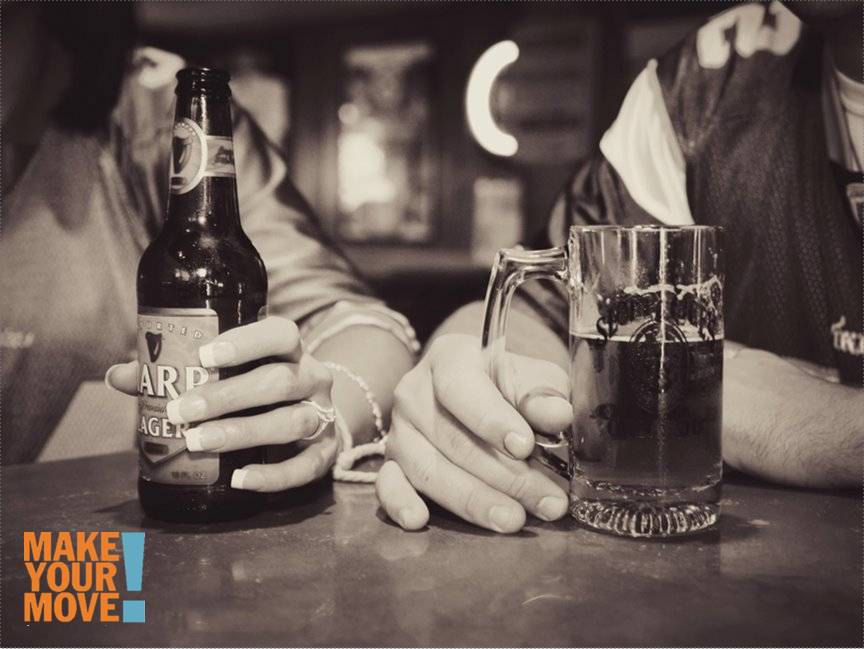
At Make Your Move! Missoula, we believe all people have a role to play in preventing sexual violence. Alcohol plays a big role in sexual violence, therefore bartenders can play an important role in stopping sexual violence before it happens. Make Your Move! Missoula has been training bar staff on bystander intervention for over a decade. Since then we have trained over 275 bartenders in Missoula.
Bar Workshop Toolkit
This toolkit was created through the support of a Raliance grant and in partnership with the Montana Coalition Against Domestic and Sexual Violence. The Bar Workshop toolkit helps community organizations across the state and around the world implement an impactful bystander intervention program. Since its creation, the toolkit has been downloaded by over 500 organizations.
What’s in the toolkit?
The toolkit includes everything your organization needs to start a bar workshop in your community. We encourage you to tailor the workshop to your local context to meet the needs of your community.
Start Up Materials
These materials will help you learn about your local community be hearing from stakeholders, local bartenders, and bar patrons.
- Stakeholder Meeting Guide
- Listening Session Facilitation Guide
- Bar Patron Survey Example
Workshop Materials
These materials will provide everything you need to facilitate the bar workshop and collaborate with local bar managers.
- Manager Meeting Overview and Agreement
- Pre and Post Workshop Survey
- Workshop Facilitation Guide
- Bar Workshop PowerPoint and Notes
- Sample Policies for Alcohol-Serving Establishments
Marketing Materials
These materials will help you and the bar advertise their participation in the bar workshop program.
- Completion Certificate
- Staff Certification Card Example
- Window Decal Example
- Patron Posters
- Sample Press Release
Who is the toolkit for?
The Make Your Move! Missoula Bar Workshop Toolkit is primarily intended for sexual violence prevention programs and victim advocates. Other types of organizations such as colleges and universities, student groups, and alcohol-serving establishments may also find the toolkit useful.
Technical assistance can be provided on a limited basis to organizations implementing the toolkit in their community. Please email us at [email protected] to get connected!
How was the toolkit developed?
Using the Raliance grant in 2016, Make Your Move! Missoula staff conducted extensive research on similar programs throughout the United States. In addition to researching best practices for bystander intervention education, we also engaged local stakeholders, bar staff, and bar patrons to create a curriculum that was realistic for the needs of local bar owners and managers, centered on issues local bar staff encounter regularly, and grounded in the experiences of bar patrons in our community.
Bystander Campaign
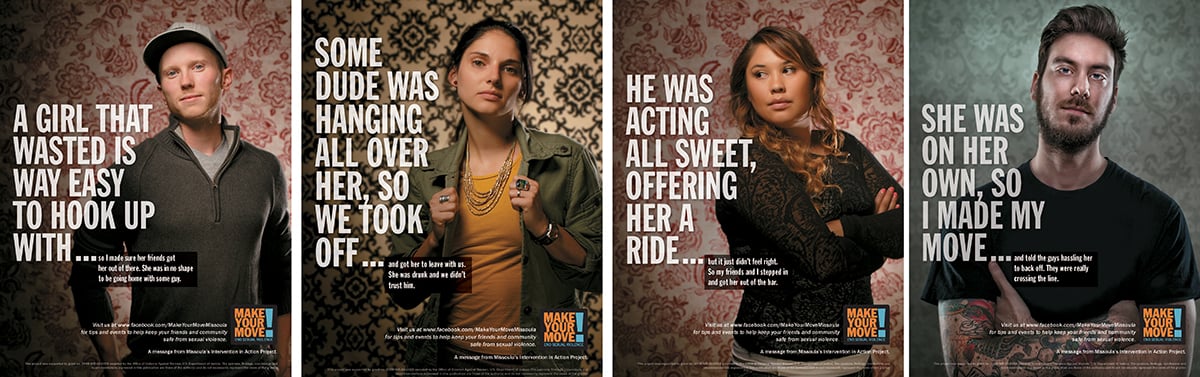
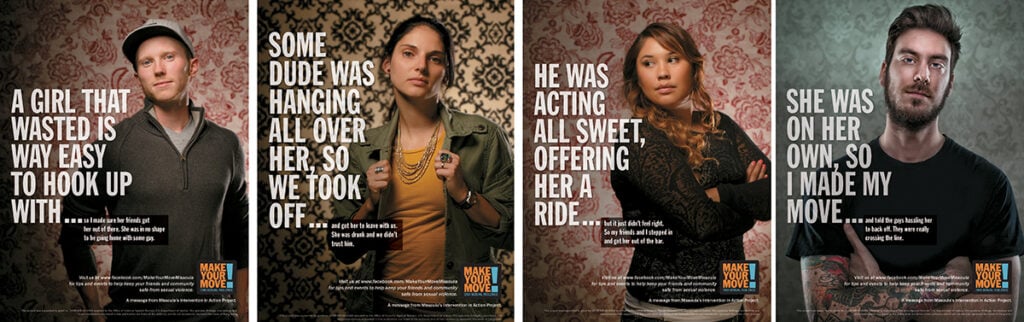
The Bystander Campaign was the first social norms campaign made by Make Your Move! It was launched in 2012. Posters were displayed in bathroom stalls across the city, placed in newspaper advertisements, and dispersed through social media. For two years, a 30 second advertisement played before movies at a local theater.
Sister Campaigns
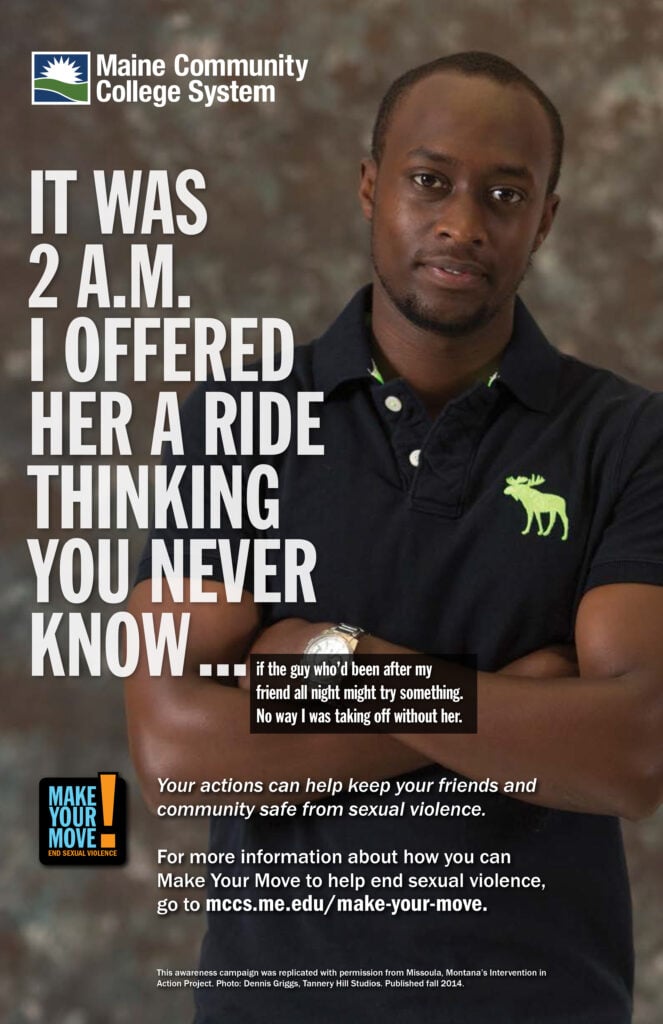
Agencies and organizations across the nation began asking for poster sets. With our support, some even made their own.
How to Launch Your Own Bystander Campaign
What’s in the toolkit?
The toolkit download includes the following. Please note you will need Adobe InDesign to edit the file templates.
- Pre-made templates for 8.5×11 and 11×17 sized posters.
- Available in .indd file format (Adobe InDesign).
- Includes document fonts and Make Your Move! logo.
What will I need?
- Adobe InDesign Software to edit the template files
- Original Photography
- Choose images that are representative of your organization or community!
- Our original posters use photos under copyright. We cannot distribute them with digital files.
- Organization Information
- You may customize your posters to include logos and information about your agency.
- If you choose to include the Make Your Move! logo, please send a proof to us to review before producing.
Participation and Copyright Policy
We welcome all organizations to participate in our poster campaign EXCEPT in the following cases:
- If the poster has a message which condones violence or implies that victims are to blame for sexual assault.
- If the person pictured in the poster is a known perpetrator of violence. We believe in every person’s ability to develop non-violent beliefs, attitudes, and behaviors. However, we will not support posters that include photos of known perpetrators of violence out of respect to the individuals who have been affected by their past actions.
All Make Your Move! posters are copyrighted by Missoula County. Poster design for the Bystander & Consent campaigns were provided by Partners Creative. The portraits for the Bystander Campaign are also copyrighted by Athena Photography.
Bystander Intervention Campaign Toolkit Download
Fill out this short form to access the toolkit.
Make Consent Explicit
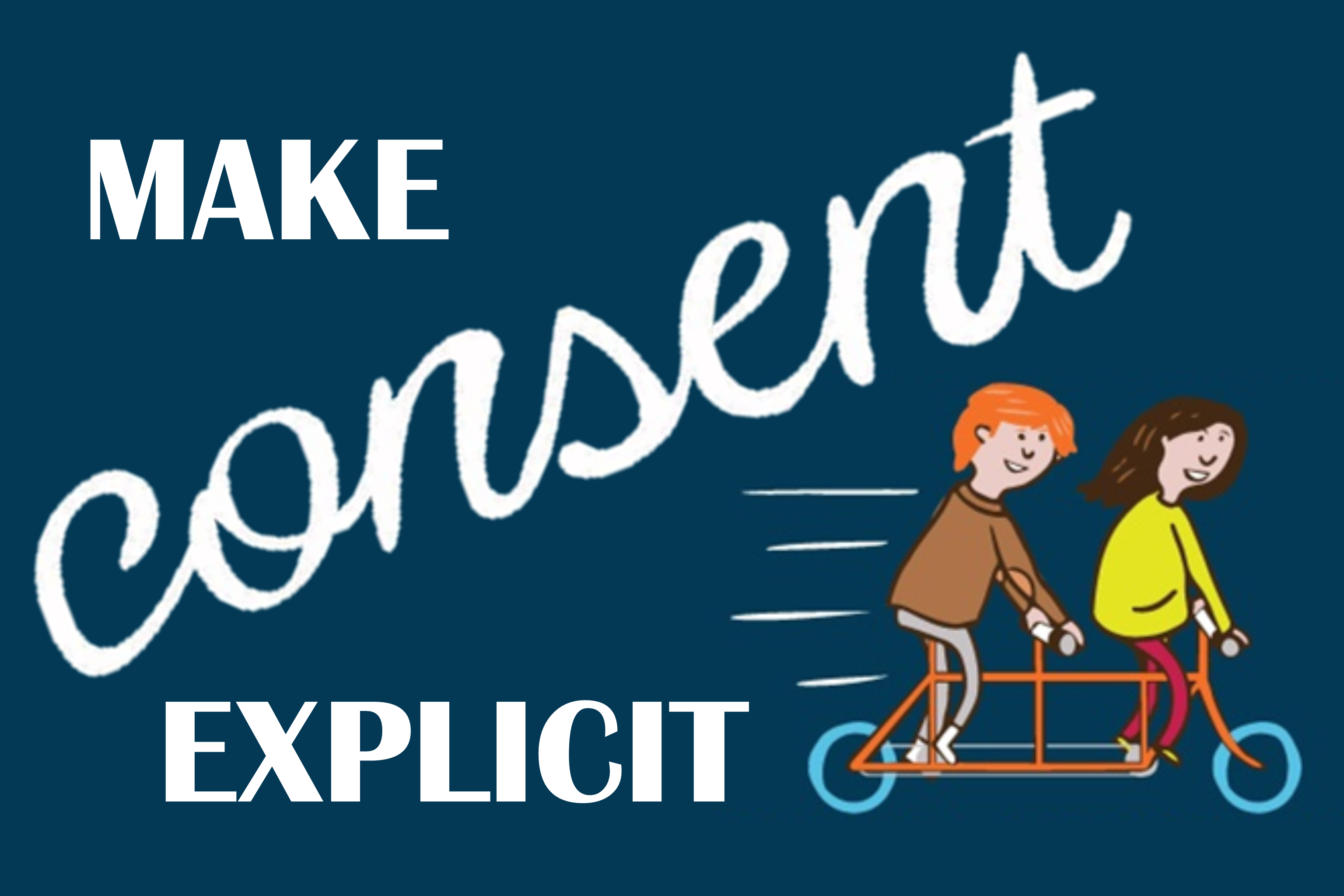
Make Your Move! launched the Consent Campaign in Fall 2017 to further promote a positive consent culture. Asking for consent can be fun, and it is always the starting point for having great sex. The campaign includes seven posters, two audio ads, and one video advertisement.
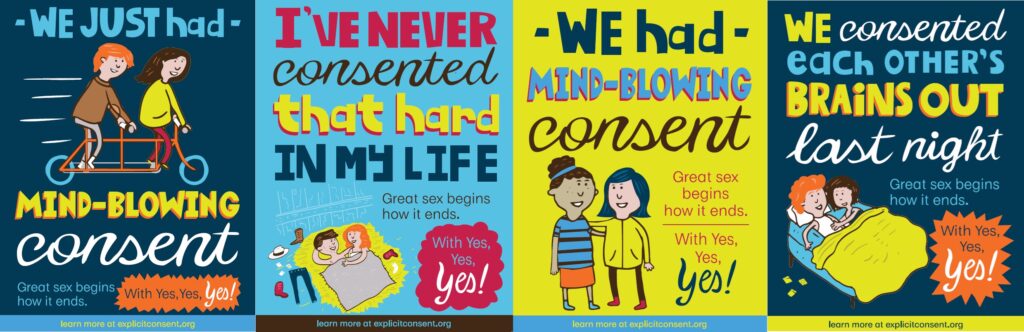
Make Your Move! posters are copyrighted by the Missoula City-County Department of Relationship Violence Services. Creative design and production for the Bystander & Consent campaigns were provided by Partners Creative. Josh Quick created the artwork for the Consent Campaign.
Distribution is limited. Please us at [email protected] for more information on promoting this campaign in your own community.
Resources
Crisis Support
If you have experienced intimate partner or sexual violence, resources are available to support you.
Local Missoula Resources
- Crime Victim Advocates
- 406.258.3830
- Provides referrals to community resources, preparation for and support at hearings, and information on rights and protections. All services are free and confidential.
- First Step Resource Center
- 24/7 Office Line: 406.329.5776
- Provides medical evaluation and evidence collection. Receiving services does not require making a report to law enforcement.
- UM Student Advocacy Resource Center
- Support Line: 406.243.6559
- Provides UM students with advocacy, counseling, and help navigating the reporting process. Services are confidential.
- YWCA of Missoula
- 24/7 Crisis Line: 406.542.1944 or 800.483.7858
- Offers confidential crisis support, walk in hours, emergency shelter, support groups, and individual therapy. Various services are available to women, men, and children.
National Hotlines and Text Lines
- RAINN: 800.656.4673
- Sexual Assault Hotline
- The Northwest Network: 206.568.7777
- LGBTQ+ Partner Abuse Hotline
- The Hotline: 800.799.7233
- Domestic Violence Hotline
- Love is Respect: 866.331.9474
- Text Chat: LOVEIS to 22522
- Teen Dating Support Line
- Stronghearts Native Helpline: 844.762.8483 (844-7NATIVE)
- Native Domestic and Sexual Violence Helpline
Defining Relationship Violence
Coercion
To unwillingly compel a partner to engage in sexual activity, through the use of pressure, persistence, guilt, alcohol, drugs, threats, or force. Additionally, when someone does not have the ability to refuse, to disengage, or to say “no,” then the behavior is coercive. Coercive behavior is not permissible in a healthy relationship. Examples of this type of behavior can include refusing to ‘get the hint’ when someone else is uninterested or manipulating a partner with statements like “you’ll do it if you love me.”
Consent
including: explicit consent, affirmative consent.
Agreement to participate. Must be made free and willingly, without pressure from a partner or other peers. A person’s agreement to an activity can change at any time, even if a person had previously agreed to participate. All participants must also have a clear understanding of which activities each person is agreeing to. The term “affirmative consent” is used to remind partners that consent should be verbal and enthusiastic.
Consent from all partners is required for any type of sexual intimacy to occur. Consent is achieved when a partner asks permission and respects their partner’s response. It is the responsibility of the person initiating sexual intimacy to ask for consent. Most people initiate some portions of sexual intimacy – especially when partners move from one position or act to another. Consent is required when transitioning to each new activity.
Montana Criminal Code Annotated defines consent as “words or overt actions indicating a freely given agreement to have sexual intercourse or sexual contact.” There are limitations to who can give consent. This includes, but is not limited to, minors, incapacitated people, and unconscious people. A disability may also impact a person’s ability to consent. To find more about various U.S. laws, you can visit RAINN’s State Law Database.
Intimate Partner Violence
including: abuse, teen dating violence, domestic violence, partner or family member assault (PFMA)
A relationship embedded in an imbalance of power and control. Among other things, abuse can take the form of emotional manipulation, financial control, placing limits on a partners whereabouts, and causing physical harm. Teen dating violence, domestic violence, and intimate partner violence are all terms that describe the same abuse of power within a relationship.
Under Montana Code Annotated, Partner or Family Member Assault (PFMA) can be charged when an individual “purposely or knowingly causes bodily injury to a partner or family member; negligently causes bodily injury to a partner or family member with a weapon; or purposely or knowingly causes reasonable apprehension of bodily injury in a partner or family member.” This is just one of many assault and related offenses connected with intimate partner violence. Other charges include stalking, strangulation, and intimidation.
People of all genders, sexual orientations, race and ethnic background, ability, and age can experience intimate partner violence.
Rape
including: sexual intercourse without consent (SIWOC).
When an act of sexual intimacy that involves penetration is enacted without consent. Penetration is defined as inserting a body part or object into an oral, genital, or anal orifice. Rape can occur when a person penetrates another against their will or when a person makes another person unwillfully penetrate.
In the Montana Criminal Code Annotated, rape is known as sexual intercourse without consent (SIWOC). This crime has been defined as “a person who knowingly has sexual intercourse with another person without consent or with another person who is incapable of consent.” Aggravated SIWOC is when a person uses force to commit rape.
Sexual Assault
Umbrella term to designate a wide variety of violating behaviors of a sexual nature. Defined in the Montana Criminal Code Annotated as “a person who knowingly subjects another person to any sexual contact without consent.”
Sexual assault includes when a person touches genitalia, breasts, or other body parts of another person in a sexual nature, without consent. Though non-consensual penetration (rape) is one form of sexual assault, these terms are not entirely interchangeable. Sexual assault refers to a broader range of violations.
People of all genders, sexual orientations, race and ethnic background, ability, and age can experience sexual assault.
Sexual Harassment
including: sexual misconduct, quid pro quo, hostile work environment
Umbrella term for a multitude of unwelcome or violating sexual behaviors. Includes, but is not limited to, sexual advances and verbal conduct of a sexual nature. Sexual harassment is a civil offense under Montana state law. Retaliation and stalking are sometimes grouped under sexual harassment, but they also often have their own policies and laws.
In schools and workplaces, sexual harassment may take on the form of “quid pro quo” or a “hostile work environment.” “Quid pro quo” is when a person demands a sexual favor in exchange for a positive outcome for the other person (for example, getting a good grade in class, or not being fired). A “hostile work environment” is a setting where a person’s conduct is so significant that it harms the productivity of another person.
Some institutions – like colleges and universities – may also have a sexual misconduct policy, which can serve as a non-legal catch-all for unwelcome sexual conduct.
Sexual Violence
Occurs when someone acts without the consent of another. This broad term covers a spectrum of violations, ranging from rape to unwanted sexual touch. It can also include unwanted sexual experiences where no contact happens, such as sexualized comments or sharing photos of a sexual nature.
Parents and Caregivers
Research shows that children, teens, and young adults value their parent’s perspectives on sex, sexuality, and relationships. It is therefore important to have conversations that extend past “The Talk”. There are so many skills involved with healthy relationships and intimacy that your loved one will need for the rest of their life. Talking to your children or teens about sex, sexuality, and relationships might not come easily if your own parents didn’t talk to you about these topics. Here are some resources to help you get started!
Healthy Relationships
- This guide from Amaze has ideas for conversation starters, key messages, book recommendations, and videos to watch with your children about healthy relationships.
- Every Body Curious has great videos for 9-12 year olds, including this one on relationships.
- This guide from Amaze has ideas conversation starters, key messages, and videos to share with your children about bullying.
Healthy Sexuality
- Planned Parenthood provides great guides for discussing sex and sexuality at different ages.
- These Amaze Jr. videos for parents have great ideas for how to support young children learning about bodies and sexuality.
Media Literacy
- Common Sense Media has a great guide on what media literacy is, why it’s important, and how to engage children at different ages about media literacy.
- Healthy Teen Network has tips on using teachable moments to discuss sex.